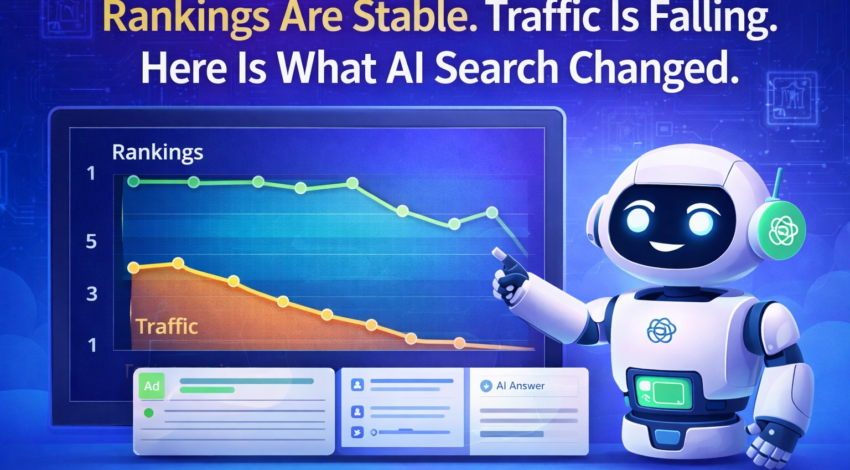
Rankings Are Stable. Traffic Is Falling. Here Is What AI Search Changed.
Traffic falling but rankings stable is the exact pattern thousands of businesses are experiencing right now. Your analytics show a confusing number. Organic traffic is down, sometimes significantly. Your team reviewed keywords. Rankings are unchanged. Position 2, position 3, position 5. All the same. So why did traffic decline? This is the complete answer.
- Rankings Are Stable Traffic Is Falling: The Real Numbers
- How AI Overview Impact Breaks Down by Keyword Type
- Why Ranking Position No Longer Determines AI Visibility
- Three Keyword Categories and Their Different Traffic Impacts
- The Counterintuitive Problem With AI Overview Citations
- Which Industry Categories Face Different Exposure Levels
- The Overlooked Opportunity on AI Platforms Beyond Google
- What Happens in Practice: A Real Scenario
- The Revenue Model That AI Search Is Disrupting
- Three Strategic Paths Forward When Traffic Is Falling
- Frequently Asked Questions
Rankings Are Stable Traffic Is Falling: The Real Numbers Behind the Shift
When Google shows an AI-generated summary at the top of search results, users get answers directly inside Google. They stop clicking your links. Traffic falling but rankings stable is not a reporting error or a tracking glitch. It is the direct result of Google changing how results are delivered, not how they are ranked. This is the core disconnect your analytics are reflecting right now.
Here is what this means in business terms. Say you ranked position 3 for 100 keywords and received roughly 1,000 clicks per month. That generated approximately 50 leads at standard conversion rates. Now Google shows AI Overviews on roughly 50 of those keywords. Your clicks from those keywords drop from 500 to approximately 270. You lose 230 monthly visitors from zero change on your part.
The direction is clear: More keyword categories experience AI Overview appearances each month. Your industry likely falls within this range and the window for strategic adaptation is narrowing consistently.
How AI Overview Impact Breaks Down by Keyword Type
Not all keywords are equally exposed to AI Overview appearances. Your specific industry trigger rate determines strategy urgency and where budget should go first. Data is directional and based on Conductor AI benchmark tracking, 2025.
| Keyword Type | AI Overview Rate | Traffic Impact | Risk Level | Primary Strategy |
|---|---|---|---|---|
| Informational (How to, What is, Why) | 88% | 35 to 50% decline | Critical | GEO and AEO |
| Science and Education | 26% | 35 to 50% decline | Severe | GEO Authority Building |
| Technology and Computing | 18% | 25 to 40% decline | High | AEO and GEO Combined |
| Local (Near me, Local services) | 5 to 15% | 15 to 30% decline | Moderate | AEO and Local SEO |
| Transactional (Buy, Pricing, Trial) | Under 10% | Under 15% decline | Low | SEO Volume Focus |
| E-commerce and Retail | 3% | 5 to 10% decline | Minimal | Traditional SEO |
| Real Estate | 2% | Under 5% decline | Minimal | Traditional SEO |
Why Ranking Position No Longer Determines Your AI Overview Visibility
This is the critical insight most SEO analysis misses entirely. For two decades, ranking position mattered because ranking position drove clicks. Position 1 received the most clicks. Position 5 received fewer. That direct relationship is no longer the primary driver of search visibility.
When an AI Overview appears at the top of results, it cites approximately 13 sources. Your ranking position does not determine whether you are cited. Your authority, content clarity, and trust signals determine citation selection. A site ranking position 3 can appear in the AI Overview. A site ranking position 1 might never appear. This happens because AI Overview source selection does not follow ranking order. It follows demonstrated authority and trustworthiness.
Google states that SEO fundamentals remain important. This is technically accurate. Strong rankings still improve citation probability. But the data shows that authority signals now play a significantly enlarged role in whether users see your brand at all. Your current strategy was built for one outcome. The landscape now requires three distinct outcomes simultaneously.
- Visibility in AI systems through citation authority signals, not just ranking position
- Trust accumulation across authoritative external platforms and publications
- Citation frequency in AI-generated summaries across Google, ChatGPT, Perplexity, and Claude
The strategic misalignment most teams face: An article ranking position 1 with zero AI citations is now worth less in terms of actual user reach than an article ranking position 5 with multiple AI citations. Most teams are still optimizing for rankings when they should be optimizing simultaneously for authority and citations.
Three Keyword Categories and Their Different Traffic Impacts Explained
Not all searches experience AI Overviews at equal rates. This distinction determines your strategy priority and which keywords to protect versus which to build new authority signals around.
Informational Keywords: Highest Risk Category
Structured as questions: “how to,” “what is,” “why should I,” “best product for use case,” “difference between X and Y.” Research from Conductor keyword analysis indicates roughly 88 percent of queries that trigger AI Overviews are informational in intent. Users ask informational questions expecting answers. AI Overviews provide those answers immediately. Users get what they came for without clicking. Publishers experienced the largest impact. Global publisher traffic from Google declined an estimated 33 percent in 2025, with the correlation to AI Overview expansion appearing direct.
Transactional Keywords: Currently Lower Risk
Commercial intent keywords: “buy,” “pricing,” “sign up,” “free trial,” “open account.” Users searching transactional keywords want to complete a transaction, not read a summary. They need to visit your site to make the purchase happen. AI Overviews appear less frequently on transactional keywords and when they do appear, transaction intent still drives clicks. But this protection is gradually eroding. Google is expanding AI Overview appearances to more query types including comparison queries. Transactional keyword categories will likely see increasing AI Overview rates over the next several quarters.
Local Keywords: Emerging Category to Monitor
Local searches like “plumber near me,” “best coffee in Hyderabad,” “dentist appointment” historically showed maps and ads first. Now they sometimes show AI Overviews too. The structural protection that exists for local keywords: users still need to physically visit or contact businesses. You cannot book a dentist appointment from an AI summary. But data on this category is still developing and monitoring is essential as Google continues expanding AI Overview coverage to new query types.
The Counterintuitive Problem With AI Overview Citations and Brand Visibility
Getting cited in an AI Overview sounds advantageous. Your site receives visibility. Your brand name appears. Users see you as an authority source. Then the business reality emerges and the numbers become difficult to reconcile with standard revenue models.
Google reports that clicks from sites cited in AI Overviews show higher quality metrics. Users spend more time on site and conversion rates exceed standard benchmarks. This data is likely accurate. But the math becomes difficult when you receive 100 clicks from something viewed by 1 million users. The volume equation does not work for traffic-dependent business models that depend on a certain visitor floor to generate sufficient leads and revenue.
For brand-authority models, AI citation visibility builds foundational trust even without immediate clicks. Users associate your brand with authority. They might visit from a different channel days later as a result. But proving that trust originated from the AI citation is nearly impossible with standard analytics tools.
For traffic-dependent revenue models, AI Overview expansion requires structural strategy change, not tactical improvement. The margin structure typically cannot support the same revenue on significantly fewer visitors until conversion rate improvements compensate.
Which Industry Categories Face Different AI Overview Exposure Levels
Your industry determines both your urgency and your strategy sequencing. The patterns below are based on Search Engine Land publisher analysis and Jasper AI search transition research, 2025.
| Industry Category | Exposure Level | Key Finding |
|---|---|---|
| Publishing and News | Most Severe | Traffic losses of 40 to 75 percent reported. Most vulnerable category overall. |
| Science and Education | Severe | Earliest and most severe impacts. AI Overviews answer educational queries immediately. |
| Technology and Computing | High | 18 percent trigger rate. Material traffic losses especially on comparison content. |
| B2B SaaS | Accelerating | Initial resilience is shifting as AI Overviews expand to comparison queries. |
| Healthcare | Relatively Stable | Google restricts AI Overviews on sensitive medical queries. Protective policy currently in place. |
| Law and Professional Services | Modest Impact | Complex human consultation requirement. AI summaries do not fully replace this need. |
| E-commerce and Retail | Low | Transaction intent drives clicks regardless of AI Overview presence in results. |
| Real Estate | Minimal | Only 2 percent trigger rate. Traditional SEO remains primary strategy for this category. |
The Overlooked Strategic Opportunity on AI Search Platforms Beyond Google
Here is the insight that separates strategic thinking from reactive thinking. Most companies are entirely focused on Google AI Overviews. Meanwhile, other AI platforms are growing rapidly and their users behave fundamentally differently.
Google AI Overview users click less and trust the summary more. The summary satisfied their need and they stop.
ChatGPT users click more and trust less. They are skeptical and want to verify independently. Zenith AI search behavior research confirms users treat ChatGPT as a starting point rather than an ending point. Perplexity users click citations approximately 41 percent of the time when citations are available. Most companies are not optimizing for either platform at all. This is a significant competitive advantage opportunity right now.
Google AI Overviews
Users trust the summary and stop. Sessions end without clicking. Traffic-dependent businesses absorb the direct impact.
ChatGPT
Users are skeptical and click citations to verify. Higher click rates than Google AI Overviews. Most businesses not optimizing here.
Perplexity
Users click citations 41 percent of the time when available. Approximately 1.2 billion monthly queries and growing rapidly.
Claude
Elevated click rates when sources are cited. Volume expanding rapidly. Platform-specific optimization creates early mover advantage.
Together, these platforms may represent the dominant search interface by 2027. If that shift occurs, being cited by ChatGPT outperforms being cited by Google AI Overviews because ChatGPT users actually click. They actually visit. They actually convert. The competitive advantage for early movers on these platforms is real and narrowing as more businesses discover this opportunity.
What Happens in Practice: A Real AI Traffic Decline Scenario
Understanding the mechanism requires a concrete example. This exact pattern has repeated across thousands of sites over the last 18 months and it consistently surprises teams who are still looking at ranking data as their primary success metric.
Scenario: “How to Start Investing” Blog Post
You maintain a blog post titled “how to start investing.” You rank position 3. Monthly clicks: approximately 400. Your revenue model has always depended on this consistent traffic volume.
Google releases an AI Overview for “how to start investing.” The Overview cites 8 sources. Your site is one of them. Your brand appears. Users see your name as an authority source.
70 percent of users find their answer in the Overview and do not click. 20 percent click competing sites featured more prominently. 10 percent click your site. Monthly clicks: 40. Your ranking: still position 3.
Your team responds by optimizing for position 2. But whether you rank position 2 or position 3 is irrelevant when the AI Overview answers the question above both results. The team is solving the wrong problem entirely.
The Revenue Model That AI Search Is Disrupting Right Now
The traditional relationship between search traffic and revenue is changing structurally. Understanding this change clearly is essential before selecting a strategic response, because the right strategy depends entirely on your specific revenue model structure.
Old Model vs New Reality
| Dimension | Old Search Model | AI Search Reality |
|---|---|---|
| Primary Equation | More traffic = More leads = More revenue | Less traffic + Higher conversion quality = Complex math |
| Monthly Visitors | 1,000 visitors at 1% conversion = 10 leads | 200 visitors at 5% conversion = 10 leads |
| The Problem | N/A | Ad budgets assumed 1,000 visitors. CPA increased 5x. Growth stalled. |
| Primary Metric | Traffic volume | Citation rate plus conversion quality |
| Strategy Type | Ranking improvement | Authority building plus multi-platform citation |
Standard SEO reporting focuses on traffic metrics. But traffic is no longer the primary business indicator when AI Overviews are present on your most important keywords. This misalignment between marketing metrics and business reality is where strategy breaks down in most organizations.
The core question your business model needs to answer: If revenue depends on visitor volume and transaction completion, you need clicks and AI Overviews create direct revenue pressure. If revenue depends on authority building and trust accumulation, AI Overviews create brand visibility opportunity. If revenue depends on qualified visitor conversion, you sit in between and need both simultaneously. Most current margin structures cannot sustain the same revenue outcomes on significantly fewer visitors without structural strategy change.
Three Strategic Paths Forward When Rankings Are Stable and Traffic Is Falling
You have three strategic options available. Most successful companies pursue all three but in different sequences based on their specific business model, revenue structure, and timeline tolerance for results.
Dominate Keywords That Do Not Trigger AI Overviews
⏱ 2 to 6 months to meaningful trafficBuild content targeting keywords that do not trigger AI Overviews. Invest in ranking and click generation on these AI-resistant keywords where traditional click behavior still applies fully. This works if your industry has sufficient non-AI keyword volume to sustain meaningful business results. Requirement: thorough keyword research to identify AI-resistant opportunities specific to your space and audience. This generates the fastest results of the three paths.
Build Authority to Get Cited Consistently in AI Overviews
⏱ 6 to 24 months to meaningful citation volumeGet your brand mentioned on authoritative sites. Publish original research data. Build visible expert profiles for your team. Make yourself the source AI systems select when generating summaries on your topic. This is long-term but compounds dramatically over time. Works best if your business can sustain 6 to 12 month strategy windows without requiring immediate traffic returns. Being consistently cited builds brand authority that converts at higher rates when users do eventually click.
Diversify Across Multiple AI Search Platforms Simultaneously
⏱ Immediate start with platform-specific strategiesOptimize for ChatGPT, Perplexity, and Claude separately from your Google strategy. These platforms have different citation selection patterns and significantly higher user click-through rates than Google AI Overviews. Most companies are not doing this at all right now. This represents a first-mover competitive advantage that will narrow rapidly as more businesses discover these optimization opportunities over the next 12 to 18 months.
Most successful companies implement all three paths. Sequence them based on your business model. Quick wins come from Path 1. Durable authority comes from Path 2. Platform diversification advantage comes from Path 3. The exact sequencing depends on your keyword landscape, industry exposure level, and current revenue model structure.
Frequently Asked Questions About AI Search and Traffic Decline
Why is traffic falling but rankings stable on my site?
Check your analytics for this specific pattern: traffic declining while rankings remain stable or unchanged. Then manually search your top 20 keywords on Google and note which ones display AI Overviews at the top of results. Compare traffic trends for those keywords against keywords where AI Overviews do not appear. The correlation usually emerges clearly within a few days of checking.
Should I stop investing in SEO entirely?
No. SEO remains essential for keywords that do not trigger AI Overviews. Strong rankings also improve your citation probability within AI Overviews that do appear. SEO is not obsolete. But SEO alone is no longer a sufficient strategy for businesses with significant informational keyword exposure.
Why does Google say I do not need to optimize for AI Overviews if it is causing problems?
Google is technically accurate: you do not need special HTML tags or metadata to appear in AI Overviews. But this statement is contextually incomplete. You do need different strategy around authority signals, citation building, and content clarity. Following Google’s guidance alone leaves significant revenue on the table.
Can I prevent AI Overviews from appearing for my keywords?
Not practically. You can use nosnippet directives to limit text extraction but this rarely prevents AI Overviews entirely. More importantly, preventing citations is not the right goal. Being cited in AI Overviews gives you visibility. Preventing citation removes that visibility entirely.
Are visitors from AI Overview clicks lower quality than regular search clicks?
No. Google’s data indicates visitors from AI-cited sources spend more time on site and convert at higher rates than standard search visitors. The problem is not quality. The problem is volume. Fewer clicks at better quality creates a revenue math challenge for models built around traffic floors.
Will AI Overviews continue to expand across more keyword types?
Yes. Google is extending AI Overview appearance to additional query types and geographic markets. By late 2025, tracking indicated AI Overviews appeared in roughly 60 percent of U.S. searches. This expansion trajectory will likely continue for at least two more years based on current data.
Which industry categories are most exposed to AI traffic decline?
Science, education, and publishing experienced the earliest and most severe impacts. Technology and software are experiencing accelerating impacts currently. Local services and e-commerce show lower exposure. Healthcare and legal services remain relatively protected for now due to query complexity and Google policy restrictions on sensitive topics.
Should I prioritize Google AI Overviews or ChatGPT optimization?
Both. But ChatGPT users click citations more frequently than Google AI Overview users do. Most companies ignore ChatGPT optimization entirely. This represents a significant competitive advantage opportunity for businesses that start building multi-platform citation authority now rather than waiting another 12 months.
How long before I see results from an AI visibility strategy?
Quick wins from citation and content optimization appear within 2 to 4 weeks. Building sustainable authority across platforms typically requires 6 to 12 months of consistent effort. Starting now creates compounding advantage over competitors who begin the same process six months later.
How do I increase my citation rate in ChatGPT and Perplexity specifically?
Focus on authority building fundamentals: publish original research with real data, get mentioned consistently on authoritative industry sites, build visible expert profiles for your team members, and establish clear and narrow topic expertise. Both platforms cite sources they perceive as authoritative, clear, and trustworthy on specific topics. The selection criteria differ slightly from Google AI Overviews and require platform-specific content approaches.
Sources and Further Reading
- Semrush: AI Search Impact Tracking and AI Overview Click-Through Rate Analysis, 2025
- Conductor: AEO and GEO Benchmarks Report, AI Overview Appearance Rates by Industry Category, 2025
- Search Engine Land: Plan for GEO 2026, Evolve Your Search Strategy, Publisher Impact Analysis
- Jasper: GEO and AEO, AI Search Transition Analysis for SaaS and B2B Businesses
- Zenith: ChatGPT AI Search Ranking Factors and User Click Behavior Across Platforms
- Google Developers: Robots Meta Tag and Nosnippet Directive Documentation
Know Exactly Where Your Business Stands Before Traffic Falls Further
An AI visibility audit shows you which keywords trigger AI Overviews, where your citation rate stands across all platforms, and which of the three strategic paths will generate the most revenue for your specific business model. No guessing. No generic recommendations. Just clarity on your actual situation and your real options.
No commitment required. No sales process unless you want one.
