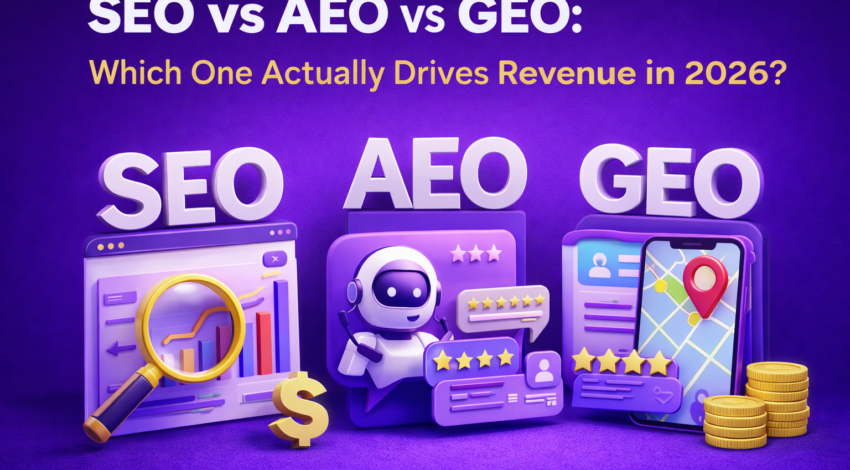
SEO vs AEO vs GEO: Which One Actually Drives Revenue in 2026?
SEO vs AEO vs GEO is the most important strategic question in digital marketing right now. For 20 years, SEO meant one thing: get to page one of Google. Today it means something entirely different. Your page-one ranking still matters. But so does being selected as the direct answer. And so does being cited when people search in ChatGPT instead of Google. Most strategies treat all three equally. They should not. This guide shows you exactly which one to prioritize first based on your actual business model.
- SEO vs AEO vs GEO: What Changed in Search in the Last 18 Months
- What Is SEO and When Does It Still Drive Revenue
- What Is AEO and How Answer Engine Optimization Works
- What Is GEO and How Generative Engine Optimization Builds Authority
- SEO vs AEO vs GEO Compared: What Each One Actually Does
- Which Strategy Drives the Most Revenue for Your Business Type
- How to Audit Your Current SEO, AEO, and GEO Position
- Your 3 Phase Roadmap for SEO, AEO, and GEO Implementation
- What We Know About GEO vs What We Are Still Testing
- Frequently Asked Questions About SEO vs AEO vs GEO
SEO vs AEO vs GEO: What Changed in Search Over the Last 18 Months
SEO vs AEO vs GEO matters more than ever because three fundamental shifts happened in the last 18 months that broke the old SEO playbook completely. Understanding these shifts is what separates businesses that are growing their search visibility from businesses that are watching their traffic decline while rankings hold steady.
Shift 1: Google Released AI Overviews at Scale
When you search for an informational query, Google now generates a summary answer at the top of the page. Your search result slides below the fold. Your clicks drop even though your ranking position did not change. Click-through rates on affected keywords fall from approximately 15 percent to around 8 percent according to Semrush AI Overview impact tracking, 2025. This is a structural change to how Google delivers results, not a change to how it ranks them.
Shift 2: People Stopped Starting Every Search on Google
Buyers now search on ChatGPT. Researchers search on Perplexity. Enterprise teams ask Claude. When the search does not happen on Google, your page-one ranking means nothing at all. ChatGPT processes approximately 2.5 billion queries monthly. Perplexity processes approximately 1.2 billion. These are not small numbers. They represent a growing share of information-seeking behavior that SEO alone cannot address.
Shift 3: AI Tools Cite Sources and Build Authority
When ChatGPT generates an answer to a question about your industry, it can cite your site as the source. You do not get a click from that session. You get something more valuable: you get authority. Your brand is associated with the trusted answer. And that association compounds over time in a way that traditional backlinks never could.
These three shifts created three entirely separate optimization disciplines that serve different goals, use different tactics, and produce results on completely different timelines. SEO, AEO, and GEO are no longer the same thing. Treating them as one unified strategy is the mistake most marketing teams are making right now.
What Is SEO and When Does It Still Drive Revenue in 2026
SEO is what most businesses have been doing for years. Optimize for keywords. Build backlinks. Improve technical performance. Earn your way to page one of Google search results. It is the foundation of organic digital marketing and it remains essential, though its role has changed significantly.
When SEO Works
Active ConditionsThe user searches on Google. The query has commercial or transactional intent. Your result is not pushed below AI Overviews. The user clicks through to your site.
What SEO Does
StrengthsGets you visible to people actively searching for your services or products on Google. Drives direct, measurable click traffic. Works immediately for transactional keywords.
What SEO Does Not Do
LimitationsDoes not guarantee clicks when AI Overviews appear. Does not make you the trusted answer. Does not get you cited by AI systems. Does not work when searches happen outside Google.
The honest truth about SEO in 2026: SEO is still important and still necessary. But it is not enough by itself. If 40 percent of your target keywords trigger AI Overviews, 40 percent of your traffic potential is already gone. Improving your ranking from position 4 to position 2 will not bring that traffic back. A different strategy is required for those keywords.
What Is AEO and How Answer Engine Optimization Works
AEO stands for Answer Engine Optimization. It is about being the answer Google shows users directly, whether in a featured snippet, in the People Also Ask section, or inside an AI Overview summary. AEO is the bridge between traditional SEO and the AI search era.
When AEO Works
Active ConditionsYour content directly and concisely answers the question. Your answer is clearly structured with headers and lists. You have implemented FAQ schema markup. Your answer is short enough to be extracted and displayed.
What AEO Does
StrengthsBuilds brand recognition even when you do not get the click. Your brand appears in featured snippets. Your brand appears in AI Overview sources. Users see you as the trusted authority on the topic.
What AEO Does Not Do
LimitationsDoes not drive bottom-funnel conversions by itself. Trades some clicks for more brand visibility. Someone seeing your snippet may not click that session. Someone seeing your brand in ChatGPT may not visit immediately.
Key insight: AEO is not a replacement for SEO. It is a complement. You are trading some immediate clicks for broader brand visibility. For businesses where brand trust drives conversion, this trade is worth making. For businesses that depend entirely on click volume to generate leads, AEO alone creates a revenue gap.
What Is GEO and How Generative Engine Optimization Builds Long Term Authority
GEO stands for Generative Engine Optimization. It is about making sure that when ChatGPT, Claude, Perplexity, or any other AI system synthesizes an answer in your industry, your content is what gets cited as the source. GEO is the newest of the three disciplines and the one with the longest time horizon for results.
When GEO Works
Active ConditionsYour content is genuinely authoritative in your field. Your brand is mentioned across multiple authoritative publications. You publish original research and proprietary data. You are clearly identified as an expert source.
What GEO Does
StrengthsBuilds long-term compounding authority. Once you are cited by AI systems, you tend to stay cited. The more you are cited, the more you are recommended. You build mind share that converts at a much higher rate when users do click.
What GEO Does Not Do
LimitationsDoes not drive clicks today. Citations do not equal immediate traffic. Your business will not improve next month from GEO work alone. GEO requires a 6 to 12 month commitment with patience for delayed returns.
GEO is still new. There are no official webmaster tools. No verified ranking factors from OpenAI or Google on how to optimize for AI citations specifically. What we know works: authority, clarity, originality, and trust signals. What we are still testing: exact weighting, citation decay speed, and how different AI systems weight signals differently. See the Search Engine Land GEO 2026 strategy guide for the latest research findings.
SEO vs AEO vs GEO Compared: What Each One Actually Does for Your Business
Here is how SEO, AEO, and GEO compare across the dimensions that matter most to your business outcomes. Based on Conductor AEO and GEO benchmark research, 2025.
| Dimension | SEO | AEO | GEO |
|---|---|---|---|
| Primary Goal | Rank in Google results and generate clicks | Be selected as the direct answer in Google | Be cited by AI systems like ChatGPT and Perplexity |
| Time to Results | 3 to 6 months | 4 to 8 weeks | 6 to 12 months |
| Primary Metric | Organic traffic and click-through rate | Featured snippet captures and brand mentions | AI citation frequency across platforms |
| Click Impact | High direct clicks | Trades clicks for visibility | Low immediate clicks |
| Authority Impact | Medium | Medium to high | Very high and compounding |
| Revenue Timeline | Fast when rankings exist | Medium term brand influence | Long term compounding revenue |
| Where It Works | Google search only | Google featured positions | ChatGPT, Perplexity, Claude, Google AI |
| Risk if Ignored | Invisible in Google | Missed brand visibility on AI answers | Invisible in 40% and growing of all searches |
Which SEO AEO or GEO Strategy Drives the Most Revenue for Your Business Type
This is where most advice gets generic. “Do all three equally” is the wrong answer. Your business type determines your priority sequence. Trying to execute all three simultaneously without prioritization wastes budget and produces slower results in all three areas.
E-Commerce Brands
E-commerce keywords are transactional. “Best backpack for hiking” is a buying signal. Featured snippets on comparison queries influence buying decisions directly. AEO wins here because you gain visibility as the trusted source on the queries that matter most, and results appear in weeks rather than months. SEO remains table stakes since buyers still search Google for products. GEO matters less because AI systems rarely recommend specific e-commerce products by name in generated responses.
B2B SaaS Companies
B2B buyers research in ChatGPT and Perplexity before they ever search on Google. They want synthesized information about solutions and alternatives. When a buyer asks ChatGPT “what are the best alternatives to Asana,” you need to be cited in that response. This influences their evaluation before they ever talk to your sales team. Authority compounds in GEO: once cited, you tend to stay cited. AEO helps with comparison content. SEO still supports discovery for buyers who use Google.
Local Service Businesses
Local searches remain largely AI-resistant. “Plumber near me” still shows Google Maps and ads first. Google Business Profile optimization is critical. Local searches still drive direct customer calls and visits. Voice search is dominant in local and voice is AI-resistant in the local context. AEO matters for voice search optimization and “near me” featured positions. GEO is lower priority because users searching for local services still need to physically interact with those businesses regardless of what an AI summary says.
Content Publishers and Media
AI Overviews are an existential threat to content publishers. Informational traffic is collapsing. Global publisher traffic from Google declined an estimated 33 percent in 2025. GEO is essential because if you are cited by AI systems you stay relevant and authoritative even as direct search clicks decline. Citations drive authority which drives future brand search volume. SEO is declining for publishers in informational categories. This is precisely why GEO is now the primary strategy for media businesses.
How to Audit Your Current SEO, AEO, and GEO Position Before Building a Roadmap
Before you build a roadmap, know exactly where you stand. Running this audit first prevents you from investing in the wrong priority and gives you a clear baseline to measure against. Use tools like Ahrefs or Semrush for the SEO portions and manual testing for GEO.
SEO Health Check: 5 Questions to Answer
- Are your top 10 keywords ranking in the top 5 positions? If not, you have basic SEO gaps to address first.
- Is your organic traffic stable or growing year over year? If declining with stable rankings, AI Overviews are likely the cause.
- Does your site load in under 3 seconds on mobile? If not, fix this before anything else.
- Do you have a clear internal linking strategy with important pages linked from multiple relevant pages?
- Is your backlink profile growing with links from authoritative sites in your industry?
Score: 4 to 5 yes answers = solid SEO foundation. 2 to 3 = gaps to fix. 0 to 1 = start here before touching AEO or GEO.
AEO Opportunity Check: 4 Questions to Answer
- Are you currently appearing in any featured snippets for your target keywords? Check Google manually for your top 20 queries.
- Do your top pages include clear summary boxes, concise definitions, and step-by-step lists structured for extraction?
- Have you implemented FAQPage schema markup on pages that include FAQ sections?
- Do you rank for any voice search queries where featured snippet results are shown?
Score: 0 to 1 featured snippets = significant AEO opportunity exists. 3 or more = you are already executing AEO well.
GEO Readiness Check: 5 Questions to Answer
- Ask ChatGPT 5 questions in your industry. Does your site get mentioned or cited in any of the responses?
- Do you have 10 or more quality inbound links from authoritative publications in your specific space?
- Is your business or brand present in relevant knowledge graphs including Google Knowledge Graph?
- Are you mentioned by name in articles and publications about your topic, not just linked to?
- Have you published original research, proprietary data, or unique industry insights in the last 6 months?
Score: Being cited by ChatGPT already = you are winning at GEO. Not cited at all = 6 or more months of authority building work ahead.
Your 3 Phase Roadmap for Implementing SEO, AEO, and GEO in Sequence
Do not try to do everything at once. Sequencing by business type and current audit results gives you faster ROI than a simultaneous approach. Each phase builds the foundation the next phase requires.
Phase 1: Understand Your Current State
⏱ Months 1 to 2Audit your top 50 keywords to identify which ones trigger AI Overviews. Check your featured snippet rate across target keywords. Audit your backlink profile for quality and growth trajectory. Manually test your GEO position by asking ChatGPT, Perplexity, and Claude questions in your industry space. Map exactly where you are vulnerable and where you have leverage.
Resources needed: SEO tool such as Ahrefs or Semrush, 5 to 10 hours for manual research, a tracking spreadsheet.
Budget: $100 to $200 for tools. $2,000 to $3,000 if outsourced.Phase 2: Capture Quick Wins With AEO
⏱ Months 2 to 4Add FAQPage schema to your top 10 pages using Google’s structured data guidelines. Restructure 3 to 5 pages to include clear summary boxes, definitions, and step-by-step lists. Create FAQ sections on pages with traffic but no answer-optimized content. Build a topical authority hub with deep, structured content on your main topic area. Optimize meta descriptions to lead with the answer.
Resources needed: Content writer for restructuring (10 to 15 hours), developer for schema implementation (2 to 5 hours).
Budget: $3,000 to $8,000 if outsourced. Expected: 2 to 3 new featured snippets within 4 to 6 weeks.Phase 3: Build Authority for Long Term GEO
⏱ Months 4 to 6 and ongoingDevelop original research or proprietary data worth citing by AI systems. Run media outreach to get your brand mentioned in authoritative publications. Position your founder or lead expert as a visible thought leader with consistent publishing. Build entity recognition with consistent brand presence and structured data markup. Execute strategic link building from authoritative sites in your specific industry space.
Resources needed: Content strategist, PR and media outreach capability, link building strategy, 20 to 30 hours per month of ongoing execution.
Budget: $5,000 to $15,000 per month for Phase 3 at enterprise scale.What We Know About GEO vs What We Are Still Testing and Learning
GEO is the newest discipline of the three and the one with the least verified guidance. There is no GEO equivalent of Google Search Console yet. No official documentation from OpenAI or Anthropic on citation factors. What follows is what the available evidence shows, separated from what we are still testing.
What We Know Works
- Authority through backlinks and brand mentions in publications
- Topical relevance and demonstrated expertise depth on a narrow topic
- Content clarity and structure that AI systems can extract and paraphrase
- Trust signals including credible authors and credible source citations
- Originality and unique insights not available from other sources
- Being cited by other authoritative sources in your field
What We Are Still Testing
- Exact weighting of authority signals (does it matter 60% or 80%?)
- Speed of citation decay once you are cited in AI systems
- Impact of engagement signals and social shares on LLM citation selection
- Whether specific metadata prevents or enables AI training on your content
- How different AI systems weight citation signals differently from each other
- How fast GEO impact will grow as AI search query volume increases
Important strategic note: Do not bet your entire strategy on GEO alone. Use it as a long-term investment while maintaining SEO and AEO in parallel. GEO tactics should complement good SEO, not contradict it. Any GEO strategy that requires sacrificing SEO fundamentals is the wrong strategy.
Frequently Asked Questions About SEO vs AEO vs GEO
What is the difference between SEO, AEO, and GEO in simple terms?
SEO gets you ranked in Google search results and drives clicks to your site. AEO gets your content selected as the direct answer Google shows users, whether in featured snippets or AI Overviews. GEO gets your brand cited when AI systems like ChatGPT and Perplexity generate answers. SEO is about ranking. AEO is about being selected. GEO is about being quoted.
What is the difference between AEO and GEO specifically?
AEO is about being selected as the direct answer in Google search results. GEO is about being cited in AI-generated responses outside of Google. AEO happens inside the Google ecosystem. GEO happens in ChatGPT, Claude, Perplexity, and other AI systems that are increasingly replacing traditional search for many query types.
Will improving my SEO hurt my AEO or GEO chances?
No. Good SEO actually helps both AEO and GEO. Clear, well-structured, authoritative content improves all three disciplines simultaneously. The tactics that make content rank well in Google also make it more likely to be selected as an answer and more likely to be cited by AI systems. There is no conflict between the three when executed correctly.
Can I do all three strategies at the same time?
You can, but it is not efficient use of budget or team capacity. Sequencing by business type gives you faster ROI. Execute the highest priority discipline first, capture its results, then layer in the next one. Most businesses see better outcomes from this sequenced approach than from splitting resources evenly across all three from the start.
Does GEO actually drive traffic and revenue today?
Not immediately. GEO builds authority and brand awareness first. Traffic and revenue impact comes later as you are cited more often and AI search grows as a share of total queries. GEO is a 6 to 12 month investment with compounding returns, not a short-term traffic driver. Businesses that start GEO now will have significant authority advantages over competitors who wait another 12 months.
How do I know if AI Overviews are affecting my SEO traffic?
Your rankings stayed the same but traffic dropped. If your page-one keywords are triggering AI Overviews, that is the cause. Check Google manually for your top 20 keywords and observe whether AI Overviews appear above your results. Compare traffic trends on keywords with AI Overviews versus keywords without. The pattern typically becomes clear within a few days of manual checking.
How much should I budget for SEO, AEO, and GEO?
Phase 1 audit: $100 to $200 in tools or $2,000 to $3,000 if outsourced. Phase 2 AEO quick wins: $3,000 to $8,000 for content and schema implementation. Phase 3 GEO authority building: $5,000 to $15,000 per month at enterprise scale with PR and link building included. Start with the phase that matches your business type priority.
Can I run SEO, AEO, and GEO in-house or do I need an agency?
Phase 1 audit you can complete yourself with standard SEO tools and time. Phase 2 AEO requires content writing skills but is manageable in-house with the right team. Phase 3 GEO typically requires external expertise for PR outreach and strategic link building at scale. The complexity increases significantly at each phase.
What is the best way to track GEO progress over time?
Currently, tracking is manual. Ask ChatGPT, Perplexity, and Claude 5 to 10 questions in your industry each month. Record whether your brand is cited. Track this in a spreadsheet over time. Some third-party tools are beginning to offer AI citation monitoring, but manual testing remains the most reliable method right now as the tooling ecosystem is still developing.
Should I focus on branded or non-branded keywords across SEO, AEO, and GEO?
Both matter but they serve different purposes. Branded keywords are AI-resistant because users specifically searching your brand name still want to click. Non-branded informational keywords are the most AI-vulnerable and the most important to address with AEO and GEO strategies. Prioritize branded keyword protection through SEO and non-branded authority building through AEO and GEO.
Sources and Further Reading
- Semrush: AI Search Impact Tracking and AI Overview Click-Through Rate Analysis, 2025
- Conductor: AEO and GEO Benchmarks Report, Industry Trigger Rates and Citation Analysis, 2025
- Search Engine Land: Plan for GEO 2026, Evolve Your Search Strategy for Generative AI
- Google Developers: FAQPage Structured Data and Schema Markup Implementation Guide
- Schema.org: FAQPage Type Documentation and Technical Reference
- Ahrefs Blog: Authority Building, Backlink Strategy, and Technical SEO Guidance
Find Out Exactly Which Strategy Drives the Most Revenue for Your Business
An AI visibility audit shows you which of your keywords trigger AI Overviews, where your citation rate stands across ChatGPT and Perplexity, and whether SEO, AEO, or GEO should be your first investment. No generic recommendations. Clear answers based on your actual data.
No commitment required. Just clarity on your actual situation and your real options.
