Healthcare SEO | Content Strategy | Patient Acquisition
How Intent-Driven Content Increased Patient Inquiries by 286% Without Increasing Ad Spend
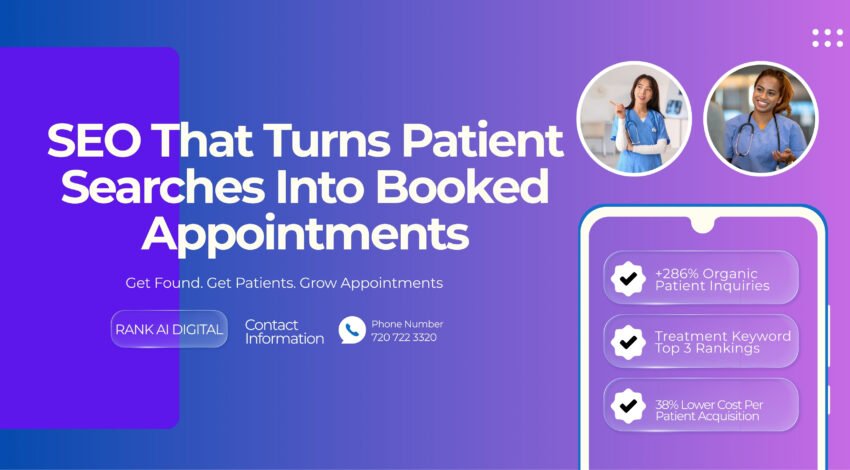
A multi-location specialty clinic network in the United States had strong local brand recognition but weak inbound patient growth from organic search. The clinic was publishing blog content consistently but it was not converting into booked appointments or qualified patient inquiries. Rank AI Digital rebuilt the entire content architecture around patient decision stages, medical authority signals, and appointment conversion optimization. In 9 months, organic patient inquiries increased by 286% with no increase in paid acquisition spend.
Why Content Was Generating Traffic but Not Patient Inquiries
Content was built around symptom education and general health awareness, which attracted early-stage readers who were not ready to book. Treatment decision content was almost entirely absent.
The blog and service pages operated as disconnected silos. There was no internal linking structure connecting symptom pages to diagnosis content to treatment options. Patients researching conditions could not naturally progress toward booking from within the site. The front desk was receiving low-intent inquiry calls that required significant education before any appointment could be scheduled.
Estimated lost treatment revenue opportunity exceeded $220,000 per quarter based on average treatment value and the gap between site traffic and conversion benchmarks.
Core Problems Identified
- Content targeting general health awareness terms only, with no treatment comparison or decision-stage content
- Blog and service pages disconnected with no shared linking structure
- No topical medical authority cluster built around primary revenue services
- No content designed for AI medical search summaries or featured snippet capture
- Appointment booking path required five steps before submission
- Heavy dependence on paid patient acquisition campaigns
Project Goals
- Increase qualified organic patient inquiries without raising ad spend
- Move treatment keywords into Top 3 positions
- Rebuild content architecture around patient decision stages
- Reduce cost per patient acquisition
Strategy and Implementation
Phase 1: Medical Content Architecture Rebuild
Four core treatment topic clusters were built around primary services. Internal linking mirrored patient journey. Keyword cannibalization resolved across 31 URLs.Phase 2: Patient Decision Content Creation
42 high-intent medical assets created across awareness, consideration, and decision stages.Phase 3: Appointment Conversion Optimization
Booking reduced from five steps to two. Treatment CTAs embedded inside educational content.Phase 4: Medical E-E-A-T Expansion
Physician-reviewed verification, credentials display, schema markup deployed following Google Search Central.Phase 5: AI Search Optimization
Content rewritten for direct-answer clarity and structured Q&A blocks aligned with AI-powered search.Project Results
| Metric | Before | After | Change |
|---|---|---|---|
| Monthly Organic Patient Inquiries | 96 | 371 | +286% |
| Appointment Requests Per Month | 96 | 371 | +286% |
| High Intent Treatment Search Traffic | 8,200 | 19,000 | +132% |
| Visitor to Appointment Conversion Rate | 1.8% | 4.1% | +128% |
| Cost Per Patient Acquisition | $312 | $194 | -38% |
| Treatment Keywords in Top 3 | — | 29 | +29 Keywords |
Additional monthly treatment revenue pipeline reached $374,000 based on CRM tracking and GA4 attribution via Google Analytics 4.
Director of Marketing, Healthcare Clinic Network