

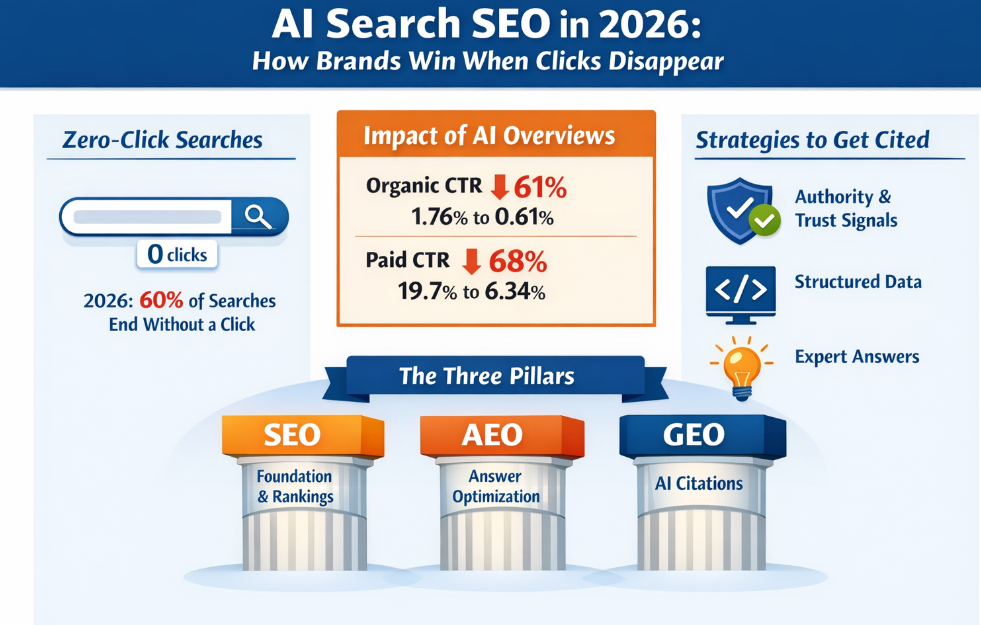
In 2026, 60% of searches end without a click. AI answers questions before users visit websites. When AI Overviews appear in search results, organic CTR drops 61% (from 1.76% to 0.61%). Paid CTR crashes 68% (from 19.7% to 6.34%). This is based on analysis of 25.1 million impressions.
Search is no longer a traffic channel first. It is a trust and discovery channel first.
The businesses winning in AI search aren’t just ranking—they’re being cited inside AI-generated answers. This guide shows you how to optimize for visibility across all AI platforms.
What Is AI Search SEO?
AI Search SEO optimizes websites for AI-driven search systems including Google AI Overviews, ChatGPT (800 million weekly active users), and Perplexity (780 million monthly queries).
Traditional SEO focused on keywords and links. AI search heavily rewards clarity, structure, authority signals, and direct answer formatting. If your content isn’t structured for AI comprehension, it gets ignored.
ChatGPT processes over 1 billion queries daily and currently accounts for roughly 80% of generative AI traffic. Among 18-24 year olds, 66% use ChatGPT to find information, nearly matching the 69% who use Google.
How This Guide Was Built
This guide synthesizes findings from multiple industry benchmark studies, analysis of AI citation behavior across major platforms, aggregation of large-scale SERP behavior datasets, and observed patterns from live client environments across multiple industries.
How Search Behavior Changed
Zero-click searches increased from 56% to 69% between May 2024 and May 2025. By December 2025, Google AI Overviews appear in 60% of search queries, up from 6.49% one year earlier. For commercial searches, AI Overviews appear in 86.8% of queries.
Ranking alone is not enough. Your content must explain what you do, who you help, and why you’re credible in ways AI systems can extract and cite.
The Three Pillars Working Together
| Pillar | Focus | Key Edge |
| SEO | Rankings & Foundation | 92% of AI citations from top 10 domains |
| AEO | Featured Snippets | Direct answer extraction |
| GEO | AI Citations | 43% citation rate increase |
Traditional SEO remains the foundation. Without strong technical SEO and authoritative content, AI systems won’t trust your site. 92.36% of AI Overview citations come from domains ranking in the top 10 for related queries.
Answer Engine Optimization (AEO) focuses on being selected as the direct answer in featured snippets, Google AI Overviews, and voice responses through question-based content and structured data.
Generative Engine Optimization (GEO) focuses on being cited by ChatGPT, Perplexity, and Gemini. Brands using dedicated GEO optimization see citation rates increase by 43%.
These strategies compound each other. Strong traditional SEO improves authority signals. AEO creates structured content AI can extract. GEO builds clarity and entity recognition that strengthens both rankings and citations.
How AI Systems Select Sources
Analysis of 2.2 million prompts identified core factors determining AI citations:
Domain Authority matters enormously. Sites with 350,000+ referring domains are 5x more likely to be cited than those with 200 domains. Author schema makes sites 3x more likely to appear in AI answers.
Content Depth and Structure significantly impact citations. Articles over 2,900 words are 59% more likely to be cited by ChatGPT. Pages structured into 120-180 word sections earn 70% more citations.
Recency drives citations. Content updated within 60 days is 1.9x more likely to appear in AI answers.
Structured Data provides context AI models parse easily. Sites implementing structured data saw a 44% increase in AI citations.
Page Speed influences citations. Pages with First Contentful Paint under 0.4 seconds are 3x more likely to be cited.
80% of cited URLs don’t rank in Google’s top 100 for the original query. AI citations create opportunities beyond traditional ranking.
Core Tactics for AI Search Visibility
1. Structure Content for AI Extraction
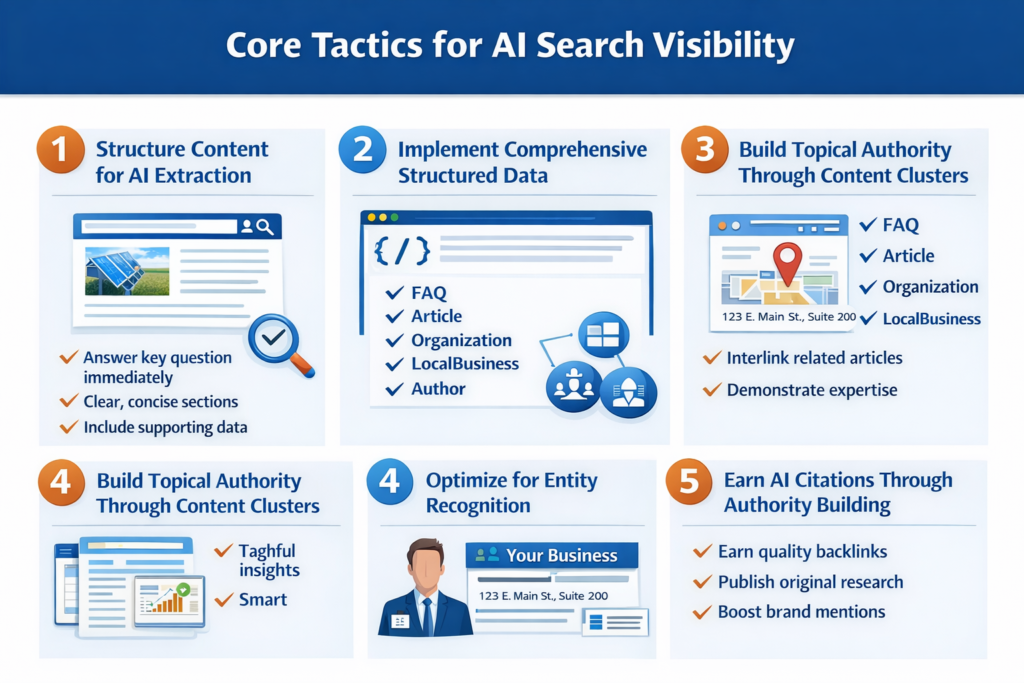
Answer the primary question in the first 120-180 words. Use natural-language questions as H2 and H3 subheadings. Instead of “Benefits of Solar Panels,” use “Why Should Homeowners Choose Solar Panels?”
Structure sections into 120-180 word blocks. Very short sections under 50 words perform poorly. Very long sections over 250 words also underperform.
Support answers with data. Pages with 19+ specific data points averaged 5.4 citations compared to 2.8 for pages with minimal data.
Example Transformation:
Before: “Our marketing services help businesses grow. We offer SEO, content marketing, and paid advertising.”
After: “How Can Small Businesses Increase Organic Traffic?
Small businesses can increase organic traffic through three proven strategies: technical SEO optimization, content marketing targeting long-tail keywords, and local SEO focusing on Google Business Profile optimization.
Our analysis of 847 small business clients shows:
- 67% increase in organic traffic within 6 months
- 43% improvement in conversion rates
- 2.3x ROI compared to paid advertising alone”
2. Implement Comprehensive Structured Data
Structured data is foundational for AI visibility.
Essential Schema Types:
- Organization schema defines your business entity, logo, contact information, and social media
- LocalBusiness schema includes address, service areas, hours, and payment methods
- Article schema marks up content with headline, author, publish date (1.9x more likely to be cited)
- FAQPage schema explicitly defines questions and answers for direct AI extraction
- Author schema identifies creators with credentials (3x more likely to appear in AI answers)
Use Google’s Rich Results Test tool to validate implementations.
3. Build Topical Authority Through Content Clusters
AI systems cite sources they perceive as authoritative on specific topics.
Create pillar content (2,000-4,000 words) on core topics. Build supporting cluster articles (1,500-2,000 words each) exploring subtopics. Link strategically with descriptive anchor text. Use consistent terminology—AI identifies authority through consistent, correct terms.
Update content regularly. Pages updated within 60 days are 1.9x more likely to be cited. Set quarterly review schedules.
Strong topical authority through content clusters increases citation likelihood by 30-50% for core topics.
4. Optimize for Entity Recognition
Define your primary business entity clearly within the first 200 words of your homepage. Use consistent brand mentions across all pages. Create dedicated service pages with clear taxonomy and individual H1 headings. Implement location pages for geographic entities with unique, valuable content.
90% of AI citations driving brand visibility originate from earned and owned media. Create comprehensive author profiles with credentials, link to author social media, and maintain consistent bylines across all content.
5. Earn AI Citations Through Authority Building
Brands cited in AI Overviews earn 35% more organic clicks and 91% more paid clicks. Getting cited requires building genuine authority signals AI systems recognize.
Earn high-quality backlinks from authoritative domains. Sites with 350,000+ referring domains are 5x more likely to be cited than those with 200 domains. Focus on relevant, authoritative sites in your industry. Guest posts on industry publications, original research citations, and expert commentary all build authority.
Build brand presence on platforms AI systems train on. Reddit accounts for 11-12% of ChatGPT citations. Participate authentically in relevant subreddits, providing genuine value. Answer questions thoroughly and build recognition as a knowledgeable source.
Get featured in industry publications and media. Tech media publishers and authoritative news sources dominate citation rankings. Pitch expert commentary, original research findings, or newsworthy stories. Media mentions signal authority to AI systems.
Create original research and data. Pages with proprietary data average significantly higher citation rates across all AI platforms. Conduct surveys, analyze industry trends, compile case studies, or publish benchmark reports.
Maintain consistent NAP (Name, Address, Phone) information across the web. Even minor discrepancies create hesitation in AI models when deciding whether to cite a source.
6. Measure AI Search Performance
Traditional metrics like rankings and clicks don’t capture AI search performance. You need new measurement frameworks.
Share of Voice measures how often your brand appears in AI-generated responses compared to competitors. If ChatGPT mentions three project management tools and you’re one of them, you own roughly 33% of that query’s share of voice. Bank of America captured 32.2% visibility across AI platforms in banking queries (June 2025).
Citation Frequency tracks how often AI systems cite your content. Tools like Ahrefs Brand Radar, Profound AI, and Goodie track citations across ChatGPT, Google AI Overviews, and Perplexity.
Citation Position measures where you appear in AI responses. Being mentioned first carries significantly more weight than appearing fifth in a list of recommendations.
AI Visibility Audits should be conducted quarterly. Manually test your top 30-50 queries across ChatGPT, Perplexity, Google AI Overviews, and Gemini to track whether you’re being cited and how prominently.
Blend Search Console data with AI tracking. As of June 2025, AI Mode clicks count toward Search Console totals under the “Web” search type. Monitor overall impression increases—you get two impressions when appearing in both AI Overview and traditional results.
Track indirect influence. Add “How did you hear about us?” fields to forms with options like “ChatGPT,” “Google AI Overview,” or “Perplexity.” Monitor branded search volume spikes following AI mentions. Analyze direct traffic patterns, as users often remember brands from AI responses and navigate directly later.
Common Mistakes to Avoid
- Creating generic, AI-generated content (AI systems favor depth and originality)
- Keyword stuffing (over-optimized content performs poorly with AI)
- Ignoring structured data implementation
- Treating GEO as separate from SEO
- Focusing only on one AI platform
- Using outdated content (maintain quarterly refresh schedules)
- Neglecting technical SEO fundamentals (page speed, mobile usability)
How to Adapt Your Strategy Now
Week 1-2: Audit and Baseline
- Conduct AI visibility audit for top 30 keywords
- Document current citation rate and competitor citations
- Identify pages lacking structured data
Week 3-4: Quick Wins
- Implement schema markup on top 10 pages
- Add FAQ sections to pillar content
- Restructure top content into 120-180 word sections
- Update publication dates on evergreen content
Month 2-3: Authority Building
- Create or expand content clusters around core topics
- Build 5-10 high-authority backlinks
- Participate authentically in Reddit communities
- Publish original research
Month 4-6: Scale and Measure
- Expand structured data across entire site
- Create new pillar content for secondary topics
- Build systematic content refresh schedule
- Track citation growth and revenue impact
The Reality of AI Search in 2026
AI search is transforming how search works. By late 2026, analysts predict AI Overviews will appear in 70-80% of informational queries.
Traditional traffic is declining. Major publishers report 20-90% traffic drops when AI Overviews appear. HubSpot saw 70-80% traffic decline on affected queries. Business Insider lost 55% of organic traffic between April 2022 and April 2025.
But opportunity exists. Brands cited in AI Overviews earn 35% more organic clicks. Early movers are establishing authority while competitors ignore AI optimization.
What Makes AI Search SEO Different
Traditional SEO asks: How do I rank first? AI Search SEO asks: How do I become the source AI systems cite?
Traditional SEO measures: Rankings, traffic, clicks. AI Search SEO measures: Citations, share of voice, brand mentions in AI answers.
Traditional SEO optimizes: Individual pages for keywords. AI Search SEO optimizes: Topical authority across content clusters with entity signals.
This shift isn’t about abandoning traditional SEO. It’s about strategically expanding to capture visibility across all search methods in 2026.
Taking Action
AI Search SEO in 2026 is not about tricks or shortcuts. It’s about making your website genuinely useful, properly structured for machine understanding, and trusted by both users and AI systems.
Start with your foundation. Implement structured data across important pages. Structure content for easy extraction with clear headings and concise sections. Build topical authority through comprehensive content clusters that demonstrate expertise. Earn citations through thought leadership and authoritative backlinks from industry publications.
Track what matters most. Measure citations, not just rankings. Monitor share of voice across AI platforms. Connect AI visibility metrics to revenue impact and business outcomes.
The companies earning consistent visibility across Google AI Overviews, ChatGPT, Perplexity, and future AI search agents are strategically unifying SEO, AEO, and GEO into a single comprehensive strategy focused on clarity, structure, and authority.
Frequently Asked Questions
What is AI Search SEO in 2026?
AI Search SEO in 2026 focuses on optimizing content for AI-generated answers, voice search, and traditional search together. It prioritizes clarity, structure, and authority.
Is traditional SEO still important?
Yes. Traditional SEO is the foundation. Without strong technical SEO and content, AI systems will not trust or cite your site.
What is the difference between AEO and GEO?
AEO targets direct answers in search results. GEO targets citations inside AI-generated responses. Both rely on clear, structured content.
How long does AI Search SEO take to show results?
Initial improvements can appear within 2 to 3 months. Strong authority and consistent AI citations usually take 6 months or more.
Can small businesses compete in AI search?
Yes. Clear niche focus, local relevance, and helpful content allow small businesses to appear in AI answers without massive budgets.
Tags:
Share:


